Career Ops
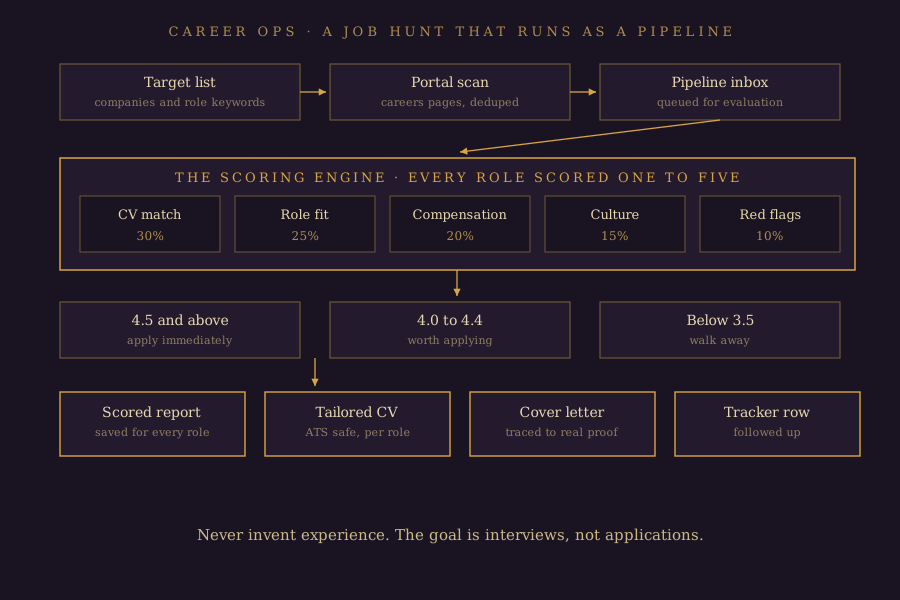
Even my job hunt has staff. Career Ops is an agent system that treats applying for jobs the way my enterprise agents treat retail data: as a pipeline with entry points, scoring, verification, and outputs. I adapted an open source scaffold and rebuilt it around my own CV, my targets, and one hard rule: the goal is interviews, not applications.
The problem: good applications do not scale
A proper application takes hours: research the company, judge whether the role is real and worth it, tailor the CV, write a letter that does not sound like everyone else's. Most people resolve that tension by spamming a generic CV at everything, which recruiters can smell instantly. I wanted the opposite trade: fewer applications, each one precise, without spending my evenings on the research.
The scanner and the pipeline
Twice a week, on a schedule, the agent sweeps startup job boards, ATS networks, and the careers pages of target companies. Every posting is fingerprinted so nothing is evaluated twice, and every candidate runs a liveness gauntlet first: too old, expired, redirecting to a generic jobs page, no apply button, discarded. The first law of the system: zero expired roles in the pipeline. Better to report no new jobs than to hand out false hope.
The scoring engine
Every role gets scored from one to five across five weighted blocks: CV match at thirty percent, role alignment at twenty five, compensation at twenty, culture signals at fifteen, and red flags at ten. The thresholds make the decision for me: above 4.5 apply immediately, above 4.0 worth applying, below 3.5 walk away. A separate legitimacy flag catches suspicious postings before any effort is spent. And every evaluation is written up as a report, scores, salary, responsibilities, and reasoning, so the decision is auditable later.
Tailoring without lying
The output side has hard rules written into the agent. Never invent experience, metrics, or proof points. Every sentence in a cover letter must trace back to a real line in the CV. Banned vocabulary includes every corporate cliche you have ever skimmed past. The CV itself is rebuilt per application: bullets reordered to mirror the job description, keywords bolded, exported as an ATS safe Word document and swept by an automated punctuation check before it reaches my desktop.
The other half: going direct
Job boards are half the hunt. The system also finds recently funded London startups, identifies the founders, and verifies their email addresses through a verification API before drafting anything; an address that fails never gets an email, so nothing ever bounces. Drafts land in my Gmail in my voice, referencing what the founder is actually building. One thing the machine never does is click send. A hundred plus roles scored, thirty plus written evaluations, twenty plus tailored document sets, and every application still passes through human eyes last. That is the design, not a limitation.